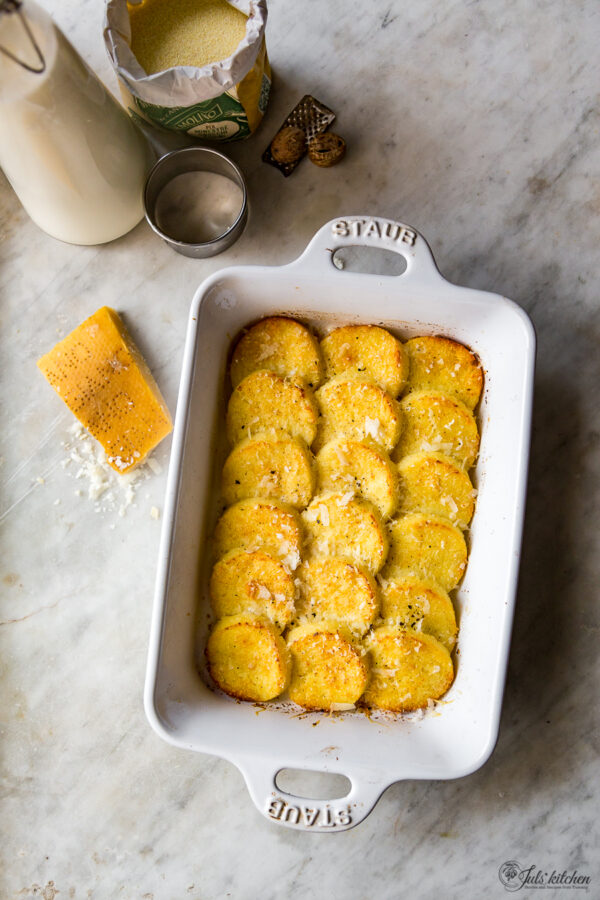
Roman style semolina gnocchi
Ingredients
- 1 l of whole milk
- Nutmeg
- 250 g of fine semolina flour
- 2 egg yolks
- 100 g of butter
- 100 g of Parmigiano Reggiano, grated
- Salt
Instructions
- Pour the milk into a saucepan and grate some nutmeg in it, about half a teaspoon.
- Bring the milk to a simmer, then sprinkle in the semolina in a slow and steady stream, stirring constantly to avoid lumps.
- Keep on stirring over medium-low heat, with a wooden spoon, for about 7-10 minutes. You will obtain a kind of thick polenta: when it will start to pull away from the sides of the saucepan and it will be too thick to stir, remove the semolina from the heat.
- Transfer the thick semolina polenta into a bowl and add the egg yolks, half of the butter and half of the grated Parmigiano. Stir until thoroughly incorporated, then taste and add more salt if needed. Now the semolina will be smooth, and quite dense, but not so much that it cannot be spread with a spatula.
- Spread the semolina in a 1 cm thick layer onto a marble surface or in a low pan. You can use a spatula or your wet hands. Let it cool down and thicken for about two hours.
- When the semolina is completely cold and solid, cut the gnocchi in your favourite shape: traditional squares or lozenges or, as it is now more common, with a 5-cm round pastry ring.
- Preheat the oven to 200°C (400°F, gas number 6).
- Place the gnocchi in a pan slightly greased with butter. Traditionally, the gnocchi were arranged in several layers, in a pyramid shape. I lined them in the pan, slightly overlapping, as my mum has always done. Do not throw away the scraps, but collect them in a smaller tray, they will not look nice, but they are as good as the well-formed ones.
- Drizzle the gnocchi with the leftover melted butter and sprinkle with the remaining grated Parmigiano, then bake until golden and crisp. Serve immediately and enjoy.
Tried this recipe?We love to see your creations! Snap a pic and tag @julskitchen and hashtag it #myseasonaltable!