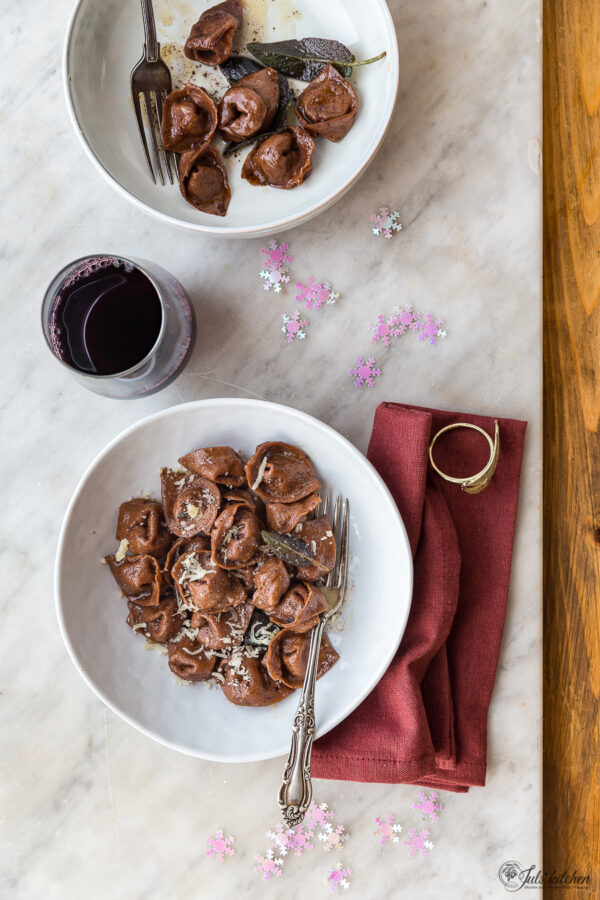
Cocoa cappellacci with butternut squash and walnuts
The cappellacci are a stuffed fresh pasta which resembles old- fashioned hats. The fresh pasta is made with the addition of unsweetened cocoa powder, so simple to prepare yet so unusual: it has only a vague hint of cocoa, do not expect a chocolate fresh pasta, but it marries beautifully the sweet butternut squash filling.
Servings 4 people
Ingredients
For the stuffing
- ½ butternut squash, about 1 pound
- 2 tablespoons of extra virgin olive oil
- 60 g (2 oz - 2/3 cup) of grated Gran Campidano di Arborea*
- 60 g (2 oz – 2/3 cup) of shelled walnuts
- ¼ teaspoon of grated nutmeg
- Salt
- Ground black pepper
For the fresh pasta
- 100 g (3 ½ oz - 3/4 cup) of 00 flour
- 100 g (3 ½ oz – 2/3 cup) of semolina flour
- 15 g (½ oz – 2 tablespoons) of unsweetened cocoa powder
- 2 eggs
- ½ teaspoon of salt
- 1 teaspoon of extra virgin olive oil
For the seasoning
- 60 g (2 oz – ½ stick) of Arborea butter
- A dozen sage leaves
- Gran Campidano di Arborea, grated
Instructions
- Start by roasting the butternut squash, so heat the oven to 200°C (390°F).
- Remove the seeds from the butternut squash and place it cut side up on a baking tray lined with parchment paper. Drizzle with extra virgin olive oil, then season with salt and ground black pepper.
- Roast the squash for about 35 minutes, until it well cooked: it will be golden on the surface, slightly caramelized on the edges and so soft that you’ll esily scoop the pulp out with a spoon.
- Remove the butternut squash from the oven and let it cool down.
- Meanwhile, prepare the fresh pasta. Mix the semolina flour, the 00 flour and the unsweetened cocoa powder on a wooden board and make a well in the middle.
- Break in the eggs and add a pinch of salt and a teaspoon of extra virgin olive oil. Mix the flour and the eggs with a fork until crumbly, then knead the dough by hands.
- Keep on kneading, to develop the gluten which will give strength to the sheets of pasta. Hold the dough with one hand while you roll it from you with the other, with the heel of the palm. After a while the dough should have the right consistency: smooth, and no longer sticky.
- Wrap it in plastic film and let it stand for 30 minutes at room temperature.
- While the pasta is resting, prepare the stuffing of the cappellacci.
- Scoop the butternut squash pulp out with a spoon and collect it in a bowl. You can discard the skin, though I like to eat it as it is, or save it up for later, as a crisp side dish.
- Toast the walnuts in a pan over medium heat for about 5 minutes, then finely chop them. Add the chopped walnuts, the grated Gran Campidano cheese and the nutmeg to the butternut squash pulp. Mash all the ingredients with a fork until you get a thick and homogeneous filling. Taste and add more salt and pepper if needed.
- After 30 minutes of rest, roll out the fresh pasta dough. The most important thing, whether you’re using a classic long rolling pin or a pasta machine, is to roll it and stretch it as much as you can. Make a paper thin wide sheet of pasta.
- Cut the pasta sheet it into 5 cm (2 inches) large squares.
- With a teaspoon or with a pastry bag place the filling in the centre of each square of fresh pasta. Fold each square in half to form a triangle and seal the edges by pressing them with your fingers. Bring the outer corners at the bottom together, overlapping the ends and pressing them together.
- It is best to proceed with a little dough at a time, so that it does not dry out in the meantime. As the cappellacci are ready, move them onto a tray sprinkled with semolina flour.
- Cook the cappellacci in plenty of boiling salted water and toss with the butter that you have melted in a pan with sage, until you ger crisp leaves.
- Spinkle with grated cheese and serve.
Tried this recipe?We love to see your creations! Snap a pic and tag @julskitchen and hashtag it #myseasonaltable!
Notes
*Gran Campidano is a hard aged cow cheese similar to Parmigiano Reggiano or Grana Padano. You can subsititue it with one of these two cheeses.